 Zadekpedia
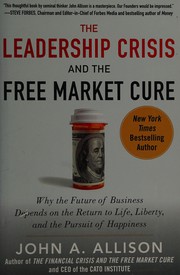
John Allison, described by Bob Zadek as former CEO of BB&T and head of the Cato Institute, appeared on The Bob Zadek Show to discuss his 2012 book The Leadership Crisis and the Free Market Cure. Zadek introduced the book as assimilating the wisdom of Aristotle, John Locke, Thomas Jefferson, and Ayn Rand. John Allison on the Leadership Crisis and the Free Market Cure (2015)
On the show
1 appearance, 2015.
- 2015-01-08 · John Allison on the Leadership Crisis and the Free Market Cure · 53:06 — The Leadership Crisis and the Free Market Cure.
Their books discussed on the show
Statism versus individualism
Allison framed American politics as a fundamental philosophical fight between statists and classical liberals or libertarians. He defined statists as people who believe in big government, believe government can solve all problems, and fundamentally believe the average person is stupid. He said statists are elitist power-lusters found on both the left and the right: on the right they usually want to control personal life, telling people whether a gay person can be married or whether they can smoke marijuana; on the left they want to take all your money. The most visible statists today, he said, are the progressives.
Allison called the whole idea of the common good an oxymoron, because practically nothing is equally good for everybody. When the idea that individuals do not matter and only the group matters is put forward, he argued, the result is group warfare—what is good for the unions, what is good for the taxi drivers, what is good for my business—in which no individual really has any right and power-lusters show up to decide which group gets what. Against this he set the Founding Fathers’ ideal of life, liberty, and the pursuit of happiness: each individual’s right to their own life, to the pursuit of their personal happiness, and to the product of their labor, including the right to give it away to whoever they want for whatever reason. That moral prerogative, he said, demands personal responsibility, and in that world the role of government is simply to protect individual rights—to keep me from using force or fraud to take what you have earned and to keep you from using force or fraud to take what I have earned.
Government and coercion
Zadek observed that government is special because it is the only institution authorized to use coercion, force, and take away liberty, and that allocating power to government therefore means allocating power to the only institution that can coerce you. Allison agreed, saying government is dangerous: throughout history, next to old age and disease, government has killed more people than any other cause—hundreds of millions, far more than terrorists and far more than the mafia. Government is needed to protect individual rights so people are not fighting each other with guns, but it must be very limited because the more power it has, the more power it abuses.
Altruism and collective ethics
Allison argued in the book for a set of values for individuals: a sense of purpose, commitment to rationality, commitment to earning happiness through rational self-esteem. He said people agree with such values individually but fail to convert them to what is right in a business and, most importantly, in society. He doubted anyone listening would take a gun to a neighbor’s house and demand half their money to give away, taking ten percent for themselves—yet it is somehow acceptable for government to do exactly that. He extended the point to regulation, saying that as individuals we would not impose constraints telling people how to run their lives, whether they could marry, smoke marijuana, make a loan to Joe, or need a license to do hair care or be a home decorator, and that perhaps 95% of regulations would not be imposed individually. Zadek compared the phenomenon to Lord of the Flies, and Allison agreed, noting that a lynch mob is a bad thing and that few individuals in one would hang people, yet collectively they do.
Entitlements, healthcare, and education
Asked how a libertarian approach would alter the country’s prospects, Allison said he would radically reduce the role of government, government expenditures, and regulation, because regulation has a huge negative impact on economic growth. That alone would not fix everything: Social Security, Medicare, and Medicaid must be taken on. For Social Security he proposed that people above a certain age—he suggested picking 50—would have to be paid, but that people under that age could go into the equivalent of a 401(k) plan, creating capital that would spur growth. For Medicare he proposed getting rid of it for people under a certain age and going to a free market in medicine, while for people over that age using a voucher system. The problem with the medical system, he said, is that there is no price competition: a doctor does not know what a service costs and neither does the patient.
Zadek offered an aside that Obamacare had perversely built a mini free market in healthcare by raising deductibles to $5,000 and $6,000, so that patients pay their own money and become careful. Allison agreed deductibles create discipline and control costs, but said health insurance in the United States is not insurance but a payment system; in a free market people would pay normal medical expenses and prices would fall, with catastrophic coverage for serious costs of $25,000 or $50,000.
On Obama’s proposal for two free years of community college, Allison said that as a libertarian he favors privatization of schools—for-profit private schools, unregulated, with the market disciplining education. He said American education has failed by objective standards because government runs the school systems, which do not innovate, are not creative, and do not teach critical thinking, and that the decline of the middle class is primarily because public schools are not teaching middle-class kids to be critical thinkers. He said he is fine with subsidizing students through tax credits or vouchers, though that is not his preference, and predicted better market solutions through the internet would arrive in the next 10 to 20 years. He also said that when something is free it will be wasted by definition.
The Cato Institute
Allison described Cato’s mission as creating a free and prosperous society based on the principles of individual liberty, free markets, limited government, and peace. He said the institute pursues this through intellectual study, policy papers, 150 seminars a year, books, educating students, and public outreach, with scholars averaging 50 major media hits a day. He stressed that Cato is not conservative and not pro-business but pro-free markets, and that it agrees with liberals on issues such as government staying out of the marriage business and adults being free to do things that may be bad for them as long as they do not hurt anybody else.
Across episodes
The episodes come from a single episode, so they show no development of a question across episodes; the topics of statism, coercion, entitlements, and education are treated only in this one conversation.