 Zadekpedia
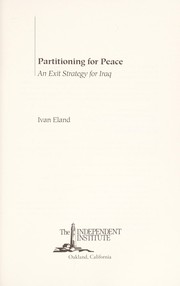
Ivan Eland is a senior fellow and director of the Center on Peace and Liberty at the Independent Institute, a think tank Bob Zadek described as located in the Bay Area. Zadek introduced Eland as a graduate of Iowa State University with an MBA in applied economics and a PhD in public policy from George Washington University, a former director of defense policy studies at Cato, and the author of Partitioning for Peace: An Exit Strategy for Iraq, noting he had spent 15 years working with Congress. Eland appeared on The Bob Zadek Show at least twice, in 2014 and 2017. United Iraq Falls: Ivan Eland on Partitioning for Peace (2014)
On the show
2 appearances, 2014–2017.
- 2014-06-29 · United Iraq Falls: Ivan Eland on Partitioning for Peace · 52:45 — US intervention in the Middle East and Iraq.
- 2017-01-21 · The Return of Big Spending Republicans? · 47:49 — National debt as a threat to national security.
Their books discussed on the show
- Partitioning for Peace: An Exit Strategy for Iraq (2009) — discussed 2014
- Recarving Rushmore (2009) — discussed 2017
Peace, liberty, and the costs of war
Eland framed his center’s work as bringing home the costs of war for people of all political persuasions, and described the nexus it studies as that between war and the erosion of liberty. He granted that nations have a right of self-defense and that most people would support World War II because the United States was attacked, but argued that wars more often than not go sour, as in Vietnam, Afghanistan, Iraq and Libya, or carry hidden costs. Among those hidden costs he named erosion of civil liberties and increasing executive power past what the Founders intended, producing what he called an imperial presidency. United Iraq Falls: Ivan Eland on Partitioning for Peace (2014)
On the first Gulf War, Eland said Saddam Hussein had invaded Kuwait, and that claims of Iraqi forces massing on the Saudi border turned out to be false because French and Russian satellites picked up no border moves. He cited a study by David Henderson, an economist under Ronald Reagan, showing that even if Saddam had taken over Saudi Arabia, Kuwait and the United Arab Emirates, US GDP would be cut by less than half of a percent, since Saddam would have to sell the oil. Eland said the elder Bush and his advisors were more honest about doing it for oil, citing Jim Baker’s “jobs, jobs, jobs,” while the younger Bush denied doing it for oil and used weapons of mass destruction as a pretext. United Iraq Falls: Ivan Eland on Partitioning for Peace (2014)
Eland extended the charge of fabricated or provoked wars beyond Iraq, naming the Mexican War as a deliberate provocation by the United States to get Mexico to attack so that it could grab Mexican territory, and agreeing with Zadek’s list of the Gulf of Tonkin and the Spanish-American War. Zadek’s own framing—that libertarians offer a third way in foreign policy and that war is only to be done in national defense—was the host’s, with Eland concurring on the offense-versus-defense distinction in a later episode. United Iraq Falls: Ivan Eland on Partitioning for Peace (2014)
Debt as the non-military threat
Returning in January 2017, Eland argued that no election was ever won on a budget deficit, because people like government benefits but are content not to pay for them, and that Republicans go soft on spending reductions. He distinguished the annual deficit as a flow from the debt as a stock, putting the national debt at almost $20 trillion. He cited Mike Mullen, then Chairman of the Joint Chiefs of Staff, who said the national debt was the biggest threat to national security, and noted that the incoming Defense Secretary had said something similar while still not wanting to cut the defense budget. The Return of Big Spending Republicans? (2017)
Eland said the United States spends what the next seven or eight countries do combined each year on defense, giving it crushing conventional and nuclear superiority, and called claims that the military has been eroded nonsense. He argued that slow growth since the 2008–2009 recession was dragged by the debt, and warned that if US growth slowed a couple of percent while China’s rose, the country could become a second-tier power. On the Trump administration, he predicted tax cuts plus increased infrastructure and defense spending, with no entitlement reform, would widen the deficit, and he described the Congressional Budget Office as a nonpartisan agency whose estimates are usually better than an administration’s. The Return of Big Spending Republicans? (2017)
Across episodes
The two episodes treat different subjects rather than the same question: the 2014 conversation concerns Iraq, intervention and partitioning, while the 2017 conversation concerns deficits, defense spending and the Trump administration’s fiscal trajectory. Eland’s critique of offense disguised as defense recurs, but the episodes show no development of a single argument between the earlier and later treatment.