 Zadekpedia
David Henderson is an economist who appears in two episodes of The Bob Zadek Show: cited by guest Ivan Eland in a 2014 discussion of Iraq, and interviewed as the featured guest in a 2019 episode hosted by Charlie Deist.
On the show
1 appearance, 2019.
- 2019-03-31 · David Henderson on Trumponomics, Deficits, and Immigration · 52:06 — Economic policies and Federal Reserve nominations.
Their books discussed on the show
- Concise Encyclopedia of Economics (2007) — discussed 2019
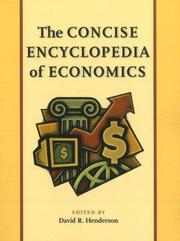
- The Concise Encyclopedia of Economics (2007) — discussed 2019
Cited in the Iraq episode
In the 2014 episode with Ivan Eland on partitioning Iraq, Henderson is not a speaker. Eland invokes him as the author of a study, describing him as an economist under Ronald Reagan as president, and summarizes its finding: that even if Saddam Hussein had taken over Saudi Arabia, Kuwait, and the United Arab Emirates — which Eland says there was really no threat of — US GDP would have been cut by less than half of a percent, because Saddam would have had to sell the oil. Eland uses the study to argue that the economic stakes of the first Gulf War were small, and that the war’s stated defensive rationale was questionable United Iraq Falls: Ivan Eland on Partitioning for Peace (2014).
The excerpt attributes the study and its conclusion to Eland’s summary, not to Henderson directly. Bob Zadek’s framing in the same segment — that libertarians hold war should be fought only to defend the country, and that the economic threat from oil was at most a short-term inconvenience — is Bob’s, not Henderson’s.
Guest appearance: Trumponomics and the Fed
Henderson’s 2019 appearance came with Charlie Deist filling in for Bob Zadek. Deist introduces him as Professor Emeritus at the Naval Postgraduate School in Monterey, California, a research fellow with the Hoover Institution, author of the popular economics blog EconLog, and editor of the Concise Encyclopedia of Economics David Henderson on Trumponomics, Deficits, and Immigration (2019).
The episode’s occasion was President Trump’s nomination of Stephen Moore to the Federal Reserve Board. Deist sets out the context: Moore, a former president of the Club for Growth, had co-authored Trumponomics with Arthur Laffer, and had written a Wall Street Journal op-ed calling the Fed and its interest-rate hikes a threat to growth. Deist raises the question of whether the Fed’s job is to promote growth or to focus on price stability and a stable dollar, and notes the concern that the nomination threatens the central bank’s independence.
Deficits, the debt, and the value-added tax
In the segment on deficits, Deist says the budget deficit grew under Reagan, and Henderson corrects him — the deficit never hit a trillion under Reagan; Deist acknowledges he meant the debt. Deist then states the national debt stands at 20 trillion and asks whether the deficit is above a trillion; Henderson says he thinks it is around 800 billion David Henderson on Trumponomics, Deficits, and Immigration (2019).
Henderson’s substantive argument in this segment concerns the value-added tax. He says US government revenues have been kept over roughly 65 to 70 years at around 17 to 18 percent of GDP, which he calls about as close to a constant as you will find in macroeconomics. He argues that when revenues approach 20 percent — as at the end of the Carter administration and again near the end of the Clinton administration — tax cuts follow. He says the only way that constant would be undercut is a value-added tax, and that although he understands the economic arguments for one, they fail to account for how the politics would change: the 17-to-18-percent figure would be breached and taxation would move toward European levels. He cites Western Europe in the mid-1960s, when countries imposing a VAT as part of European agreements split between those aiming at revenue neutrality, those aiming to reduce revenues as a share of GDP, and those aiming to increase them — and says the ones that intended to increase revenues succeeded, while the others failed. He concludes that a standard optimal-tax analysis can show a VAT is better, but only by holding constant the amount of revenue raised, which he says should not be held constant.
Taxation as social engineering
Asked by a caller about the persistent political ambition to raise taxes into the range of declining revenues, Henderson points to Emmanuel Saez, who teaches at Berkeley, and his co-author Gabriel Zucman. He says they argue explicitly that they do not want high marginal rates of 70 to 80 percent for revenue — they admit it might not, and perhaps probably will not, raise revenue — but to go after an oligarchy and reduce wealthy people’s wealth and therefore their influence in the political system. Henderson states he is not agreeing that this is a good idea, but that it is their argument. He distinguishes, in response to the caller, between those who genuinely want revenue and are ignorant of behavioral responses to taxation, and economists like Saez and Zucman who are clear on those responses and want them David Henderson on Trumponomics, Deficits, and Immigration (2019).
Across episodes
The two episodes do not develop a shared argument. Henderson appears in 2014 only as a cited study author in Eland’s case against the Iraq war’s oil rationale, and in 2019 as an interviewed economist on fiscal and monetary policy; the episodes show no continuity between the two treatments, and no position of Henderson’s is revisited across them.