 Zadekpedia
Thomas Fleming was a historian and author described by Bob Zadek as one of the nation’s leading historians of the American Revolution. Zadek said Fleming had written around twenty nonfiction books on American history and twenty-three novels, and that he was a past president of the Society of American Historians and a sailor in World War II. Fleming was an honorary member of the Society of the Cincinnati, an organization founded in 1783 by veterans of the American Revolution; he explained that membership is restricted to descendants of officers, one officer descendant per family, divided by state like the original thirteen. He said he received the honor during the Bicentennial after giving many speeches to the society for which he was never paid, and that he was the George Washington scholar for the New York State Society of the Cincinnati. George Washington Was Our Guest (2011)
On the show
3 appearances, 2011–2012.
- 2011-06-04 · George Washington Was Our Guest · 53:34 — Money and politics in the early American Republic.
- 2011-10-01 · Who Should Be President and Why? · 50:23 — The American Presidency and the Founders Vision.
- 2012-10-20 · Was The Ratification of the Constitution A Mistake? · 50:35 — Ratification of the US Constitution and Anti-Federalist Arguments.
Their books discussed on the show
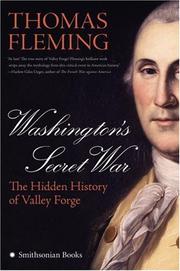
- Washington’s Secret War: The Hidden History of Valley Forge (2006) — discussed 2011
Channeling George Washington
Fleming wrote a blog on the History News Network in which he “channeled” George Washington. He described the origin of the practice as hearing a voice say, “To see this country happy is so much the wish of my soul, nothing else can compare to it, this side of Elysium,” which he recognized as something Washington wrote to a friend while deciding whether to attend the Continental Congress and risk the reputation he had achieved as general of the armies during the Revolution. Fleming said the blog imagines Washington commenting on politics from the viewpoint of someone who has been watching the country for over two hundred years from Elysium. George Washington Was Our Guest (2011)
Money and politics
Zadek framed the discussion around the McCain-Feingold Act, which he called an anti-free speech, anti-First Amendment piece of legislation, and the Citizens United case, which he said allowed corporations and unions to spend as much as they want in support of a candidate while barring direct contributions. Fleming said the Founders were no more united on money and politics than Americans are today, but that Washington would be appalled by current finance laws and inclined to agree there should be no restraints on free speech. Fleming cited a Washington motto as a guide: “We must take men as they are, not as we wish them to be.” George Washington Was Our Guest (2011)
Fleming illustrated the practicality of money through the Valley Forge winter, when three hundred officers resigned because they could. He said Washington warned that the army would not survive unless officers received pensions, that Sam Adams and John Adams objected loudly in Congress, and that the measure carried by one vote. Washington got his way, the pensions were granted, and the resignations stopped. George Washington Was Our Guest (2011)
Property, majority tyranny, and the executive
Fleming said property requirements for voting reflected a common-sense idea of the Founders’ generation: unless a man owned a certain amount of property—in some states as little as $50 or $100—and had a stake in the country, he was likely to vote for reckless ideas. He noted that the distribution of wealth in 1787 was about the same as now, with the top ten percent owning fifty percent of the property, but that a thriving middle class made the United States a successful republic. Fleming attributed to James Madison the idea that majority rule can be just as tyrannical as a dictator, and said Madison also believed legislative tyranny was a danger few were willing to recognize. George Washington Was Our Guest (2011)
On the presidency, Fleming said Washington wanted the president to be a figure known to all the people and made a point of visiting every state while in office. He recounted that John Hancock, then governor of Massachusetts, sent word that he would be happy to see President Washington when Washington called on him, and Washington replied that he would be even more pleased to see Governor Hancock when Hancock called on him first. Jefferson and his followers called these trips “royal progresses.” George Washington Was Our Guest (2011)
Corporations and the 1792 crash
Asked how the Founders viewed corporations, Fleming said there were not enough corporations in the first ten years of the Republic to make much difference in politics. Wealthy men and bankers such as Robert Morris of Philadelphia participated in politics freely, running for office or supporting those who did, as part of their rights as citizens. Fleming said he did not think the Founders got into the corporate issue to any great extent, but that they had a strong sense of ongoing conflict between rich and poor. He described writing an article for American Heritage magazine titled “The First Bubble,” about the first stock market crash in 1792, when a man named Duer tried to corner the market in shares of the Bank of the United States, failed, and lost his shirt. Fleming said Jefferson, then Secretary of State, was ecstatic over the crash and wrote in a letter that there was not a single man in New York who was not bankrupt. George Washington Was Our Guest (2011)
Across episodes
The episodes come from a single episode, which touches on money and politics, the Society of the Cincinnati, and Washington’s presidency; the episodes show no development across episodes.