 Zadekpedia
Ilya Somin is a professor of law at George Mason University School of Law who focuses on constitutional law and property law issues. He is the author of Democracy and Political Ignorance, subtitled Why Smaller Government is Smarter, and Free to Move: Foot Voting, Migration, and Political Freedom. He appeared as a guest on The Bob Zadek Show to discuss voter ignorance, foot voting, and court packing.
On the show
6 appearances, 2013–2022.
- 2013-09-21 · Is America Doomed by Voter Ignorance? · 82:34 — Voter ignorance and the impact on democratic governance.
- 2016-05-28 · Ilya Somin on Democracy and Political Ignorance · 51:52 — Democracy and Political Ignorance and Smaller Government.
- 2019-04-18 · How to Create a Legitimacy Crisis · 50:32 — Court packing and Supreme Court reform.
- 2020-05-14 · Foot Voting > Ballot Voting · 52:12 — Foot Voting Migration and Political Freedom.
- 2021-08-23 · Hard Questions About Asylum and Afghanistan · 50:13 — Immigration and asylum policy in the Afghanistan crisis.
- 2022-08-15 · 3 Libertarian Ideas to Strengthen Democracy · 52:46 — Libertarian proposals for the Guardrails of Democracy project.
Their books discussed on the show
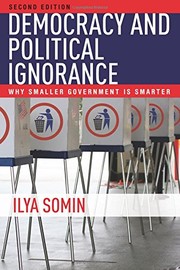
- Democracy and Political Ignorance: Why Smaller Government is Smarter (2013) — discussed 2013, 2016, 2019, 2020
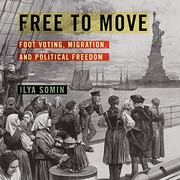
- Free to Move: Foot Voting, Migration, and Political Freedom (2020) — discussed 2020, 2021, 2022, 2022
- The Grasping Hand (2015) — discussed 2020
Voter ignorance and rational ignorance
Bob Zadek introduced Somin as a professor of law at George Mason University School of Law who focuses on constitutional law and property law issues. Somin said he had been interested in voter ignorance for at least 15 years, since he was a student, and argued the problem affects almost all other policy issues because public opinion influences policy. He cited polling data showing that most of the public greatly overestimates the amount of money spent on foreign aid—thinking it is at least 5 to 10 percent of the federal budget when in reality it is less than 1 percent—and greatly underestimates spending on Medicare and Social Security. A poll conducted in April by the Kaiser Foundation found that 42 percent of the public did not realize that Obamacare was still the law. A 2006 poll found that only 42 percent of the public could name the three branches of the federal government. Somin also noted that governors in farm states tend to be blamed for droughts, and that incumbent politicians get a boost when local sports teams win championships, even though they did not cause these events. Is America Doomed by Voter Ignorance? (2013)
Somin argued that it makes very little sense to become informed beyond a minimal level if one’s only reason is to be a better voter, because the chance any one vote will make a difference is infinitesimally small—roughly one in 60 million in a presidential election. He distinguished voting from becoming informed: voting is an extremely low-cost activity, perhaps half an hour, so it can be rational to vote if one cares about fellow citizens and believes there is a substantial difference between the two sides. Acquiring political knowledge, by contrast, is much more costly in time and effort. He described “political fans” who enjoy following politics and cheering on their favorite party or candidate; such people know more about politics than the average person but often do a poor job of evaluating information because they overvalue what confirms their preexisting views and ignore what cuts against them. Ironically, Somin said, the people who know the most about politics are some of the most biased in how they evaluate information. Is America Doomed by Voter Ignorance? (2013)
Somin addressed the argument that uninformed voters cancel each other out, leaving informed people to decide outcomes. He said this is only likely to work if errors in one direction almost exactly offset errors in the other, and the data on most issues suggests this is not true—increasing people’s knowledge significantly changes the distribution of opinion. He added that the options themselves would likely differ if voters were better informed, because political professionals know they face a mostly ignorant electorate and craft different strategies and platforms accordingly. Is America Doomed by Voter Ignorance? (2013)
Court packing and judicial legitimacy
In a 2019 episode, Bob Zadek and Somin discussed court packing and its implications for the American judiciary. They examined the historical precedent set by FDR, the potential for a legitimacy crisis within the Supreme Court, and alternative reforms such as judicial term limits. The episode also addressed judicial review, Merrick Garland, the Bill of Rights, and separation of powers. How to Create a Legitimacy Crisis (2019)
Foot voting as an alternative
In a 2020 episode, Somin discussed his book Free to Move: Foot Voting, Migration, and Political Freedom. He and Bob Zadek explored why foot voting—the ability to choose which government to live under by moving—is often a more effective and informed mechanism for political freedom than traditional ballot box voting. The conversation covered the economic and moral implications of internal and international migration, as well as regulatory barriers like zoning and occupational licensing that restrict human mobility. Topics also included federalism, economic freedom, the zero-sum fallacy, and Kelo v. City of New London. Foot Voting > Ballot Voting (2020)
Across episodes: voter ignorance and foot voting
The 2013 episode and the 2020 episode both address the limits of ballot-box voting, but the episodes show a shift in emphasis rather than a formal development. In 2013, Somin focused on why voters are rationally ignorant and how that ignorance affects policy; in 2020, he advanced the argument that foot voting is often a more effective and informed mechanism for political freedom. The 2019 episode on court packing touches on judicial legitimacy rather than voter ignorance directly, but all three appearances connect to a consistent theme of skepticism toward concentrated political power.